

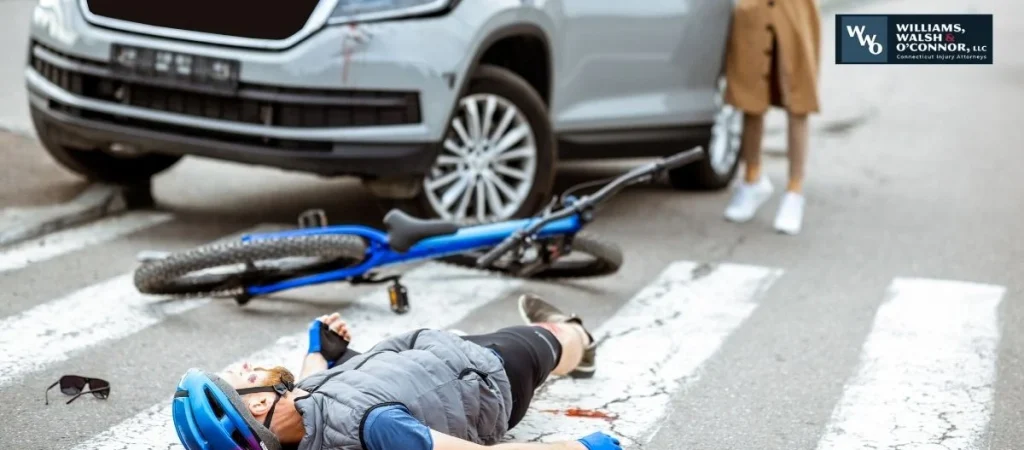

Driver Duties at Crosswalks and Intersections
When a motor vehicle driver strikes a pedestrian or cyclist at an intersection or marked crosswalk in Connecticut, legal fault generally rests with the driver if the non-motorist was lawfully in the roadway. Under Connecticut pedestrian law, drivers must yield to non-motorists crossing within designated crosswalks.
Determining who is at fault when a car hits a pedestrian or cyclist in Connecticut requires evaluating whether the driver exercised due care and respected right-of-way rules.
Connecticut law establishes strict statutory duties for motorists approaching marked and unmarked crosswalks under C.G.S. § 14-300. A motor vehicle driver must slow down or stop completely when a pedestrian steps into a crosswalk on their side of the road. When an insurer evaluates a pedestrian injury claim, liability insurance adjusters examine whether the driver breached this statutory duty.
In contested cases, crash reconstruction specialists analyze braking marks and impact locations to confirm driver visibility and timing.
Establishing fault at crosswalks requires connecting driver actions directly to roadway records and physical evidence. Law enforcement officers review traffic signal sequencing, skid marks, and damage patterns to determine if a driver improperly entered a crosswalk or cut through a designated bike lane. A motor vehicle driver who fails to yield during a turn at a green light often creates clear liability, but insurers may allege comparative negligence if entry was sudden.
The legal outcome of a crosswalk collision directly influences financial recovery options for injured pedestrians and bicyclists across the state. If evidence demonstrates that the driver violated right-of-way statutes, the injured party can pursue full compensation for damages through a formal claim notice served on the driver’s insurance carrier. However, if the insurer establishes shared fault, financial recovery may be reduced proportionately. Preserving traffic camera footage remains an essential immediate step.
Ultimately, drivers bear a heightened legal responsibility to remain vigilant for vulnerable road users at all traffic intersections and pedestrian crossings. When a collision occurs, traffic camera records, physical debris, and bystander statements help establish whether the motorist failed to yield. Identifying fault accurately allows crash victims to seek necessary coverage for medical expenses and wage losses through liability insurance.
Pedestrian Right-of-Way Rules
Pedestrians in Connecticut have the right of way in marked crosswalks and at unmarked intersections, provided they enter the roadway safely and comply with active traffic control signals. Under Connecticut pedestrian law, drivers are required to stop for pedestrians within a crosswalk. However, pedestrian right of way is not absolute; non-motorists cannot step off a curb abruptly into oncoming traffic when a vehicle is too close to yield safely.
Connecticut General Statutes govern non-motorist rights and responsibilities across municipal streets and state highways. When a pedestrian initiates an injury claim, evidence preservation becomes crucial in demonstrating that the pedestrian entered the intersection lawfully. State law prohibits motorists from passing any vehicle that has stopped at a crosswalk to permit a pedestrian to cross. A driver who violates this rule and strikes a pedestrian faces clear statutory negligence.
Police crash reports serve as foundational evidence when establishing pedestrian right-of-way violations during formal legal proceedings. Responding officers document physical evidence, weather conditions, signal cycles, and any admission of fault made by either party. In severe accidents or hit-and-run events, investigators collect surveillance footage from nearby businesses to verify who held the right of way before defense insurers assert comparative negligence.
Understanding how Connecticut pedestrian bicycle accident fault is evaluated helps victims navigate complex post-accident procedures effectively. When a pedestrian follows all pedestrian regulations, the driver’s insurer is typically required to cover all associated economic and non-economic damages. If you were struck while crossing a street, obtaining a police report and seeking relevant Connecticut legal guidance protects your legal rights.
Pedestrian right-of-way determinations ultimately rely on physical roadway evidence, witness accounts, and applicable statutory standards. When a car strikes a pedestrian who was legally in a crosswalk, liability insurance coverage is generally triggered to address medical costs and lost wages. In disputed cases, crash reconstruction helps reconstruct the precise sequence of events to establish fault and support a personal injury claim.
Bicycles as Vehicles Under Connecticut Law
Under Connecticut law, bicycles are classified as vehicles, meaning cyclists possess the same rights and responsibilities as motor vehicle drivers on public roadways. Cyclists must obey all traffic signals, stop signs, and lane markings, and drivers must yield to cyclists just as they would to any other vehicle. When a car collides with a cyclist in a travel lane or bike lane, liability depends on right of way.
Connecticut General Statutes § 14-232 establishes specific rules for bicycle operation, including the requirement that drivers pass cyclists with at least three feet of clearance. When approaching an intersection, a motor vehicle turning right must yield to a cyclist traveling straight in a bike lane or along the shoulder. If a driver cuts off a cyclist while making a turn, the driver is typically liable, unless shared fault applies.
Investigating a bicycle-car collision requires thorough analysis of physical bike damage, road markings, and electronic evidence. The responding officer documents the exact collision point on the official police report, noting whether the cyclist was in a marked bike lane or riding lawfully along the margin. Video captured by a nearby traffic camera or vehicle dashcam, alongside a witness statement, provides decisive proof of driver fault.
Because cyclists are vulnerable to severe trauma in motor vehicle collisions, asserting bicycle rights under Connecticut bicycle law is vital for securing appropriate compensation. Injured riders should never assume they are automatically at fault simply because they were riding on two wheels. Securing legal representation from Williams, Walsh & O’Connor, LLC allows injured cyclists to gather crucial scene evidence and defend their lawful right of way.
In summary, bicycles are recognized as vehicles under Connecticut law, affording cyclists full protection under statutory traffic codes while requiring adherence to traffic regulations. When a motorist strikes a cyclist through reckless passing, failure to yield, or distracted driving, an injury claim can be filed against the driver’s auto policy. Success hinges on immediate evidence preservation to establish right of way.
Comparative Negligence and Shared Fault
Connecticut follows a modified comparative negligence system under C.G.S. § 52-572h, which determines financial recovery when both parties share blame for an accident. An injured pedestrian or cyclist can recover damages from a negligent motor vehicle driver as long as the non-motorist’s fault is not greater than 50 percent. If a non-motorist is 51 percent or more at fault, recovery is barred.
Under Connecticut’s comparative fault rules, any financial award granted to an injured party is reduced proportionately by their percentage of fault. For instance, if a court determines a cyclist was 20 percent responsible for an intersection accident because they lacked proper lighting, their total damage award will be reduced by 20 percent. Insurers frequently raise shared fault defenses, making formal claim notice filings and detailed investigations essential.
Defending against unfair allegations of shared fault requires concrete objective proof gathered immediately following the crash. Insurance adjusters regularly review traffic camera recordings, phone records, and vehicle telemetry to argue that a pedestrian was distracted or outside a crosswalk. To counter these assertions, victims must present crash reconstruction diagrams and witness testimony proving that the motor vehicle driver was responsible.
Because even a minor percentage of attributed fault directly reduces total financial recovery, managing comparative negligence arguments is a critical component of any Connecticut accident claim. Establishing that a cyclist remained within a marked bike lane or that a pedestrian entered a crosswalk properly protects the claim’s full value. Victims should refrain from making recorded statements to insurance adjusters before they hire a car accident lawyer.
In conclusion, shared fault rules in Connecticut create a threshold where non-motorists can seek compensation only if their responsibility remains at or below 50 percent. Whether an accident occurred at an intersection or a traffic signal, evaluating speed, visibility, and legal compliance determines how comparative negligence affects the final settlement or verdict.
Hit-and-Run and Uninsured-Driver Scenarios
When a driver flees the scene of an accident or lacks auto insurance, an injured pedestrian or cyclist in Connecticut can still seek financial recovery through Uninsured Motorist (UM) coverage. Under state law, motor vehicle liability policies issued in Connecticut must include UM coverage, which steps in to pay medical bills and lost earnings when a hit-and-run driver cannot be identified. Filing a police report is mandatory.
Connecticut law strictly mandates that motorists involved in an accident causing injury stop immediately, render aid, and report the event to local law enforcement. A driver who commits a hit-and-run faces severe criminal penalties under C.G.S. § 14-224. For the injured victim, determining who is at fault in a car-hits-pedestrian/cyclist hit-and-run situation in Connecticut requires submitting an uninsured motorist claim within strict contractual notice deadlines.
Securing UM benefits following a hit-and-run accident relies heavily on rapid evidence collection and meticulous documentation. Law enforcement officers use physical evidence from the crash scene, such as vehicle paint transfer, shattered glass, and camera logs, to locate the fleeing vehicle. Crash reconstruction experts analyze impact dynamics to confirm the sequence of events, providing the necessary proof required by the liability insurance carrier for an injury claim.
Navigating uninsured motorist coverage requires strict adherence to policy conditions and state statutory rules. Insurance companies often handle UM claims with adversarial scrutiny, attempting to apply comparative negligence rules to reduce payout obligations. Injured non-motorists must maintain detailed records of medical care, document the scene thoroughly, and verify that their motor vehicle driver policy terms cover pedestrian or cycling activities before submitting formal paperwork.
Ultimately, a hit-and-run or uninsured driver scenario does not automatically leave an injured pedestrian or cyclist without financial options. By leveraging personal auto policies, resident relative coverage, or state funds, victims can access critical support for medical bills and lost wages. Timely submission of a formal claim notice to the insurance provider preserves vital legal remedies.
Cameras, Witnesses, and Crash Reports
Objective evidence—including surveillance video, eyewitness accounts, and official police reports—is essential for proving liability in pedestrian and bicycle accident claims. Because drivers and victims often give conflicting statements after a crash, independent evidence provides an unbiased account of signal light status, vehicle speed, and right-of-way adherence. Securing traffic camera footage and neutral witness statements immediately prevents key proof from being lost.
Official police accident reports carry significant weight during initial insurance evaluations and pre-trial settlement negotiations. Responding officers evaluate physical evidence, document weather conditions, measure skid marks, and record statements from all involved parties under Connecticut pedestrian law and bicycle statutes. While police reports themselves face evidentiary rules in court, underlying physical measurements, photographs, and officer notes form the bedrock of an injury claim.
Effective evidence preservation begins in the immediate aftermath of a collision at an intersection. Nearby security cameras from local businesses, municipal traffic hardware, and vehicle dashcams frequently capture the exact moments leading up to impact. Attorneys dispatch investigators to canvas the area, subpoena municipal camera footage, and record formal witness statements before memories fade, ensuring that the truth of the collision is preserved.
Failing to secure objective evidence early can allow defense insurers to blame the victim or assert comparative negligence defenses without challenge. In hit-and-run cases, footage from surrounding security cameras is often the only mechanism available to identify the fleeing vehicle. Victims who prioritize immediate gathering of police reports, photographic evidence, and witness contacts significantly strengthen their ability to obtain full compensation.
Insurance Claims and Next Steps
Filing a personal injury insurance claim following a pedestrian or bicycle collision requires systematically proving driver negligence, documenting injuries, and calculating full financial damages. Once liability is established through physical evidence and official reports, the injured victim can seek recovery for medical expenses, income losses, pain and suffering, and rehabilitation costs. Claims are typically submitted to the at-fault driver’s liability insurance policy.
Connecticut operates as a fault-based auto insurance state, meaning the party responsible for causing the crash is financially liable for resulting damages. However, insurance adjusters frequently use aggressive tactics to minimize payouts, questioning the necessity of medical treatments or arguing that the victim was outside a crosswalk or bike lane. Understanding statutory rights under Connecticut law empowers victims to reject lowball settlement offers.
A successful insurance claim requires comprehensive documentation linking the driver’s traffic signal violation or improper turn directly to the victim’s physical injuries. Medical records, physical therapy notes, wage loss evaluations, and crash reconstruction reports are compiled to build an indisputable demand package. Demonstrating clear driver liability minimizes insurance company claims of shared fault and establishes a solid foundation for litigation.
Hire a Car Accident Lawyer
Taking prompt, strategic action after a collision is critical for protecting your health and financial future. Injured non-motorists should seek immediate medical treatment, retain copies of every police report, track out-of-pocket expenses, and avoid making unrepresented statements to insurance adjusters.
The seasoned legal team at Williams, Walsh & O’Connor, LLC, has 150 years of combined experience pursuing compensation for Connecticut residents who have been injured due to negligence. They have successfully resolved many personal injury cases, with numerous multimillion-dollar verdicts and settlements. Highly respected in the legal community, members of the firm have been selected to the Super Lawyers list multiple times, demonstrating exceptional achievement. *
To protect your legal rights and explore all available compensation avenues, schedule a free consultation with an experienced Connecticut car accident attorney from our firm today.
FAQs
Who Is At Fault if a Cyclist Hits a Pedestrian?
Under Connecticut law, cyclists owe a duty of care to pedestrians and must yield the right of way on sidewalks and in crosswalks. If a cyclist strikes a pedestrian due to speeding, failure to yield, or distracted riding, the cyclist is generally at fault for resulting injuries. Liability is established by examining traffic regulations, physical evidence, and witness accounts.
Who Is At Fault if a Pedestrian Is Hit by a Car?
A motor vehicle driver is usually at fault if a pedestrian is struck while lawfully inside a crosswalk or crossing an intersection with a walk signal. However, fault depends on specific facts; if a pedestrian enters traffic against a signal or jaywalks dangerously, Connecticut’s comparative negligence rule may apportion blame between both parties.
Who’s At Fault if a Pedestrian Gets Hit While Walking on a Red Hand?
Crossing against a “Don’t Walk” or red hand signal violates Connecticut traffic statutes, which can indicate pedestrian negligence. However, the driver may still share fault if they were speeding, distracted, or failed to exercise due care to avoid the pedestrian under C.G.S. § 14-300. Financial recovery depends on whether the pedestrian’s fault exceeds 50 percent under state comparative negligence laws.
Do Pedestrians Have a Right of Way in CT?
Yes, pedestrians have the right of way in Connecticut when crossing inside marked crosswalks or at intersections when traffic signals indicate it is safe to proceed. Motorists must yield or stop for pedestrians within these areas under C.G.S. § 14-300. However, pedestrians must obey traffic signals and yield when crossing outside designated crosswalks.
*Past results do not guarantee a similar outcome. Every case is different and must be evaluated on its own merits. Awards and recognition are not guarantees of future results. Selection criteria vary by organization.


